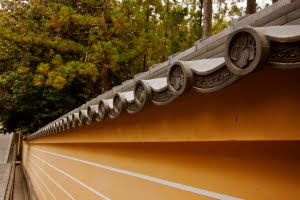
Fushimi Inari Shrine
 The Shinto Fushimi Inari Shrine was begun in 711. The five deities of this shrine represent the fundamental ancestral deities who protect the necessities of human life. The shrine serves as the protector for business and merchants as well as for rice, sake, farmers and their crops.
 "The fox is considered the sacred animal of the five deities in that its bushy tail represents fruitful years of rice harvests while the precious stone in the mouth of some of the fox images represent the spirit of the deities. The key in the mouth of other such images stands for the key to rice granaries." according to the Walking Tours of Kyoto book.
 As you walk through the shrine area you come to a continuous line of over 10 thousand vermilion tori gates donated to the shrine through the years. They wind up to the very top of the hill along a 2.5 mile walk up to the top of the mountain. There are breaks where side shrines and sacred stones are along the mountainside. Take a walk with us...


 We walked about one mile of it and decided we had gotten the feel of the walk. As you get further along the path becomes steps that become steeper as you go. There are small rest areas along the way for refreshment or to purchase small tori gates to write wishes on and leave on special boards. It was a fun venture. Back down the hill and to the bus stop
 These lovely ladies were at the bus stop.
Kiyomizu-dera Temple
This temple dates back to 778 and it's present buildings constructed in 1633. There is not a single nail used in the construction. Kiyomizu means "clear or pure water" and takes its name from a waterfall on the premises.
This temple dates back to 778 and it's present buildings constructed in 1633. There is not a single nail used in the construction. Kiyomizu means "clear or pure water" and takes its name from a waterfall on the premises.
 These young students greeted us at Kiyomizu-dera Temple.
 To the left is the vermillion gate into the Shrine area.
 This temple was loaded with people today! Thousands of students and quite a good number of tourists also.
 Dragon Fountain for handwashing before entering Temple.
 Statue of Budda's Mother
This hall is famous for it's "Kiyomizu Stage" built out over a 13' cliff.
 Three-story Pagoda
 another view of the Temple...
 This area is undergoing a major renovation.
 Otowa Waterfall is located at the base of Kiyomizudera's main hall. It has waters divided into three separate streams. The visitors use cups attached to long poles to drink from them. Each stream's water is said to have a different benefit, namely to cause longevity, sucess at school and a fortunate love life. However, drinking from all three streams is considered greedy.
We then headed back to the Heian Shrine area to the Kyoto Handicraft Center. They had several floors of handmade items.
 M
M
Marquetry boxes.
 A artist making dolls.
After wandering awhile we headed back to the hotel and stopped at our favorite ice cream shop after we got off the bus.
 We have stopped here more than once and they are now greeting us "Welcome back again." :-) We went across to the hotel, had showers, downloaded some pictures and headed back to the train station for some dinner. Tried pasta tonight...quite good. Super day again!
 Three-story Pagoda
 another view of the Temple...
 This area is undergoing a major renovation.
 Otowa Waterfall is located at the base of Kiyomizudera's main hall. It has waters divided into three separate streams. The visitors use cups attached to long poles to drink from them. Each stream's water is said to have a different benefit, namely to cause longevity, sucess at school and a fortunate love life. However, drinking from all three streams is considered greedy.
We then headed back to the Heian Shrine area to the Kyoto Handicraft Center. They had several floors of handmade items.
 M
MMarquetry boxes.
 A artist making dolls.
After wandering awhile we headed back to the hotel and stopped at our favorite ice cream shop after we got off the bus.
 We have stopped here more than once and they are now greeting us "Welcome back again." :-) We went across to the hotel, had showers, downloaded some pictures and headed back to the train station for some dinner. Tried pasta tonight...quite good. Super day again!